Introduction
Concrete is inherently strong in compression but weak in tension. Shrinkage, temperature changes, and early-age settlement create tensile stresses that cause cracking. Traditional reinforcement (rebar, welded wire mesh) controls structural cracking but does not address the very fine, early-age and surface cracks that most affect appearance, permeability and long-term durability. Synthetic micro‑fibers — particularly monofilament polypropylene (PP) fibers — are an established, cost‑effective solution for secondary reinforcement aimed at controlling plastic shrinkage, reducing surface cracking and improving surface integrity.
This article looks in depth at Monofilament PP Fiber 3MM (NovaStar® from LANDU): what it is, how it works, technical properties and mechanisms, performance benefits and limitations, recommended use and mixing practice, testing and standards, best‑practice quality control, design considerations, comparison with alternative fiber types, practical case examples, environmental and safety aspects, and a practical FAQ.
What is Monofilament PP Fiber 3MM?
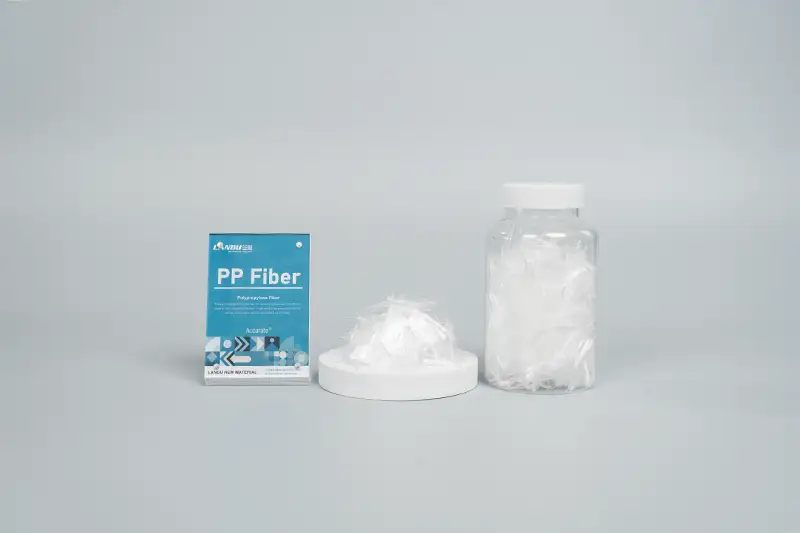
Monofilament PP Fiber 3MM is a short (nominally 3 mm long), single‑filament polypropylene fiber produced for dispersion throughout concrete and mortar mixes. As a monofilament (one continuous filament per fiber element) rather than fibrillated or bundled fiber, it is engineered to disperse homogeneously and form a three‑dimensional micro‑mesh within the matrix. NovaStar® Monofilament PP Fiber 3MM is designed specifically as secondary (micro) reinforcement — to control plastic shrinkage cracking, improve surface wear resistance, and enhance durability without substituting for structural reinforcement.
Key Material Attributes
Material
100% polypropylene (PP), homopolymer or copolymer depending on specification
Form
Monofilament single‑strand fibers, nominal length 3 mm
Specific Gravity
Approx. 0.90–0.92 g/cm³ (typical PP value ≈ 0.91)
Melting Point
Typically ~160–170 °C (PP softens and melts in this range)
Chemical Resistance
Excellent to a broad range of acids and alkalis found in concrete environments
Special Properties
Non‑corrosive and electrically non‑conductive
How Monofilament PP Fibers Work in Concrete
Monofilament PP fibers act at the micro‑scale to alter the behavior of fresh and hardened concrete:
Early-age Crack Control
Fibers are distributed throughout the mix and intercept and bridge microcracks as they form during plastic shrinkage and drying. By transferring stresses across tiny cracks, fibers reduce crack width and delay crack coalescence into larger, visible cracks.
Plastic Period Benefits
During the plastic stage (first hours after placement), fibers help control bleed and mitigate the rapid loss of moisture and resultant differential shrinkage at the surface that causes plastic shrinkage cracking.
Toughness and Post‑cracking Behavior
While microfibers do not replace structural reinforcement, they increase the post‑crack toughness and energy absorption at the micro‑scale. This improves surface resistance to abrasion and impact.
Fire and Spalling
At elevated temperatures (fire), PP fibers melt at ~160–170 °C and create micro‑channels through the matrix as they disappear. This can reduce pore pressure buildup and mitigate explosive spalling in some dense concrete sections.
Durability
PP fibers are chemically stable in alkaline cement environments and will not corrode (unlike steel), helping preserve concrete integrity over time.
Performance Benefits — What Adding Monofilament PP Fiber 3MM Achieves
Effective Plastic Shrinkage Crack Control
Monofilament PP fibers are especially effective at the very early age (first day) when the concrete is plastic and vulnerable to shrinkage cracking. By controlling hairline and map cracking across slabs and pavements, they reduce water ingress that can accelerate freeze‑thaw damage, rebar corrosion and surface deterioration.
Improved Surface Durability and Abrasion Resistance
Even at low dosages, microfibers create micro‑reinforcement across the surface layer, improving resistance to abrasion and surface wear. This is particularly useful for industrial floors, warehouses, pavements and overlays.
Reduced Bleeding and More Stable Finishing
Fibers help control bleed water migration to the surface and stabilize the mix, making finishing operations more predictable and reducing the risk of surface defects.
Chemical Resistance and Long‑term Stability
Polypropylene is chemically resistant to acids and alkalis common in concrete environments; the fibers remain stable and do not corrode, maintaining long‑term performance.
No Corrosion Risk and Compatibility with Reinforcement
Being non‑metallic, PP fibers do not create corrosion cells and can be used in conjunction with steel reinforcement, stainless reinforcement or other systems without adverse interactions.
Fire Behavior Benefit
Melting of PP fibers at elevated temperatures provides a secondary benefit in fire conditions by forming micro‑channels that can relieve vapor pressure and reduce spalling risk in dense concrete.
Limitations and Realistic Expectations
Not a replacement for structural reinforcement: Monofilament PP Fiber 3MM is a secondary reinforcement specifically for micro‑crack control and surface durability. It will not provide the same structural tensile capacity or ductility as rebar, welded wire mesh or macro/steel fibers.
Limited Contribution to Post‑crack Flexural Strength
Microfibers generally have modest contribution to flexural capacity compared to macro or steel fibers; they mainly control cracking width and distribution.
Workability Effect if Overdosed
Excessive fiber content or poor mixing can lead to fiber balling, reduced slump and finishing issues.
Melting at Elevated Temperature
While beneficial for spalling mitigation, melting means PP fibers cannot provide mechanical reinforcement at fire temperatures.
Typical Technical Properties
Note: Indicative values only; request product datasheet for exact values
| Property |
Value |
Notes |
| Fiber Length |
3 mm (nominal) |
Standard specification |
| Diameter |
30–120 microns |
Depending on product grade |
| Specific Gravity |
~0.90–0.92 g/cm³ |
Typical PP range |
| Tensile Strength |
~300–700 MPa |
Typical industrial range for PP monofilament |
| Elongation at Break |
10–40% |
Depending on type |
| Melting Point |
~160–170 °C |
Standard PP range |
| Chemical Resistance |
Excellent |
In alkaline and acidic conditions typical in concrete |
Recommended Dosages and Mix Design Guidance
Dosage depends on application objective, slab thickness, exposure conditions and finish requirements.
Typical Dosage Ranges for Monofilament PP Fiber 3MM:
| Application |
Dosage Range |
Typical Dosage |
| Plastic shrinkage control / secondary reinforcement for slabs and pavements |
0.6–1.2 kg/m³ |
0.9 kg/m³ |
| Increased durability and abrasion resistance (industrial floors, overlays) |
0.9–1.5 kg/m³ |
1.2 kg/m³ |
| Special applications (shotcrete top layer, repair mortars) |
0.6–2.0 kg/m³ |
Variable |
Note: These are indicative ranges. Local practice, finish requirements and performance targets may require adjustments. Higher dosages can improve crack control but may affect workability and finishing; always validate with trial mixes.
Mixing and Dosing Best Practice
Add Fibers Directly to the Mixer
For best dispersion, add the fibers into the mixer early during batching (after coarse and fine aggregates are in the drum) or just after initial batching. This reduces the risk of clumping and ensures the fibers are uniformly distributed.
Avoid Hand Feeding into Fresh, Pumped Concrete Line
If dosing into a continuous operation (pump), ensure suitable dosing equipment and slow, controlled release to prevent accumulation in the hopper.
Ensure Adequate Mixing Time
Allow sufficient mixing time after fiber addition (as recommended by LANDU — typically 2–5 minutes in standard mixers) to obtain a uniform distribution; shorter mixing times can lead to non‑uniform dispersion.
Check for Fiber Balling
If fibers are supplied in bales or bundles, ensure they are free‑flowing before addition. If balling occurs on site, remove and remix or adjust dosing method.
Workability Adjustments
Fibers minimally affect workability at recommended dosages, but high dosages can reduce slump. Adjust water content, use plasticizing admixtures (superplasticizers), or modify aggregate grading if needed.
Finishers and Trowel Blades
Finishing crews should be made aware of fiber content; with microfibers, finishing procedures are largely unchanged but proper timing is still critical to avoid surface defects.
Example Calculation: Dosing for a 100 m² Slab, 150 mm Thick
Frequently Asked Questions (FAQs)
Q: Can Monofilament PP Fiber 3MM replace rebar or welded mesh?
A: No. These microfibers are for secondary reinforcement (shrinkage control and surface durability). Structural reinforcement must still be designed and installed as required.
Q: Will PP fibers reduce my slab cracking entirely?
A: Microfibers significantly reduce early plastic shrinkage and limit crack widths but cannot eliminate all cracking. Proper mix design, curing and jointing are still essential.
Q: What about finishers — will fibers affect troweling?
A: At recommended dosages, Monofilament PP Fiber 3MM has little to no adverse effect on finishing. Ensure finishing starts at the optimal time and train crews about fiber presence.
Q: Can I use them in pumped concrete?
A: Yes, with proper dosing techniques and mixing. Avoid fiber clumping in hoppers; use suitable dosing equipment and ensure adequate mixing time.
Q: What is the effect at high ambient temperatures?
A: Higher ambient temperatures can accelerate plastic shrinkage. Fiber use is especially beneficial in hot, windy or low‑humidity conditions; additional curing measures are recommended.
Q: Are they suitable for external, exposed concrete surfaces?
A: Yes, microfibers are resistant to alkaline and acid conditions typical in concrete and are suitable for exposed slabs, pavements and overlays.
Conclusions and Practical Recommendations
Monofilament PP Fiber 3MM (NovaStar®) provides an effective, economical means to control plastic shrinkage cracking and improve surface durability and finish quality in a wide range of concrete applications. Key practical recommendations:
Secondary Reinforcement Use
Use as a secondary reinforcement for early‑age and surface crack control (dosage typically 0.6–1.5 kg/m³).
Optimal Dispersion
Add fibers during batching for optimal dispersion and avoid balling.
Quality Control
Perform trial mixes and on‑site QC (slump, air, mixing time, visual dispersion).
Comprehensive Approach
Combine with good curing practice, appropriate jointing and structural reinforcement where required.
Technical Support
Obtain supplier datasheet and certificates and consult LANDU for specific project design support.

 Dutch
Dutch  English
  Arabic
  German
  Ukrainian
  Greek
Greek  Spanish (Spain)
  Spanish (Peru)
  French
  Hungarian
  Indonesian
  Italian
  Portuguese (Portugal)
  Turkish
  Russian
  Slovak
  Swedish
  Bulgarian
  Czech
Czech  Danish
  Estonian
  Finnish
  Japanese
  Korean
  Lithuanian
  Latvian
  Norwegian
  Polish
  Romanian
  Portuguese (Brazil)
  Slovenian
  Azerbaijani